


Overview
Nordstrom (NYSE: JWN), the U.S. department store retailer, announced recently that the company’s board of directors has formed a special committee, composed of independent and disinterested directors, to evaluate a proposal by the founding Nordstrom family to take the company private at $23 per share. This proposal, representing $3.8 billion in equity value, marks the second time in recent years that the Nordstrom family has sought to take the company founded by John W. Nordstrom in 1901 private in order to execute a comprehensive business transformation outside of the fishbowl scrutiny of the public markets. The prior proposal, rejected by the board of directors in 2018, was valued at $50 per share, or approximately $7.5 billion in equity value.
From a business transformation standpoint, what is going on here, and what lessons can be learned for small and midsize organizations and those who support them?
A Sector in Turmoil
The U.S. department store sector is undergoing wrenching change. This retail subsegment, once a powerhouse, is now in secular decline, both in nominal and percentage of GDP terms (see Exhibit A). As could be expected, this decline represents a considerable headwind for any company seeking to chart a profitable and value accretive path forward.
Exhibit A: Headwinds
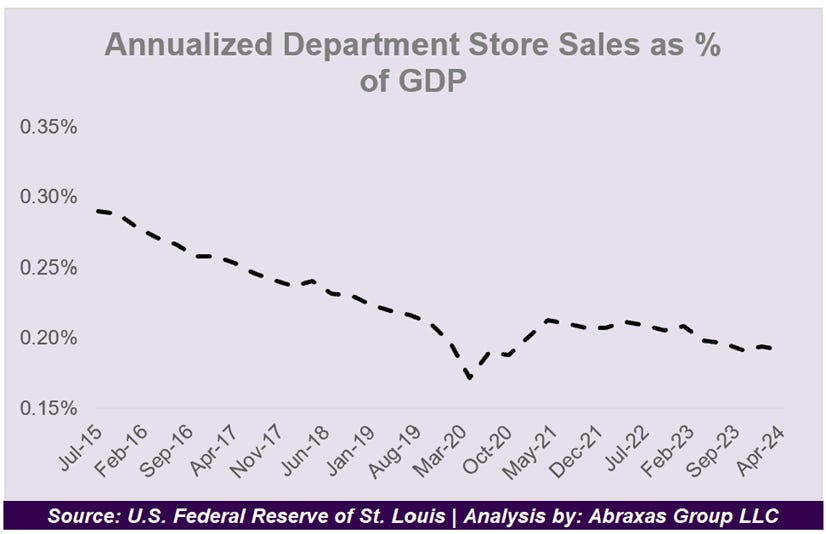
Note: U.S. GDP in 2017 Chained Dollars
To add insult to injury, the struggles of the department store segment come when other areas of retail are seeing growth. Direct to consumer (DTC) has become the default retail channel for many younger consumers and the ease of that channel has altered the shopping habits of consumers of all ages. DTC continues to account for a growing share of consumer spending. However, even among the brick-and-mortar options, departments stores are laggards. According to the Deloitte 2024 U.S. retail industry outlook, department stores ranked last in consumer spending trends, with a -11% YoY change for 2022-2023, and an only slightly less ugly -8% YoY change for 2021-2022.
Department stores are the sick man of the retail landscape, and the list of companies in the sector that have experienced struggles is imposing:
Sears Holdings. Filed for bankruptcy in October 2018.
Neiman Marcus. Filed for bankruptcy in May 2020.
JCPenney. Filed for bankruptcy in May 2020.
Lord & Taylor. Filed for bankruptcy in August 2020.
Belk. Filed for bankruptcy in January 2021.
Macy’s. Recently announced 150 store closures.
To state an obvious but often elided point with companies facing difficult circumstances: survival is a necessary but not a sufficient condition for success. Success here can be defined as a company achieving a strategically defensible market position in which it is growing (both revenue and profitability) and creating incremental value for shareholders. Leadership of any department store company in the U.S. must appreciate that they are the survivors of a segment in secular decline. Charting a course forward will require an embrace of the need for a comprehensive business transformation. To succeed, leadership teams must be willing to acknowledge the serious challenges they face, objectively assess their opportunities, summon a willingness to make difficult decisions, and act decisively.
A Company Struggling with Change
The public markets are not a natural or an inviting home for companies in need of a business transformation. Norstrom faces several critical strategic questions that would be more easily resolved outside of the glare of public market scrutiny:
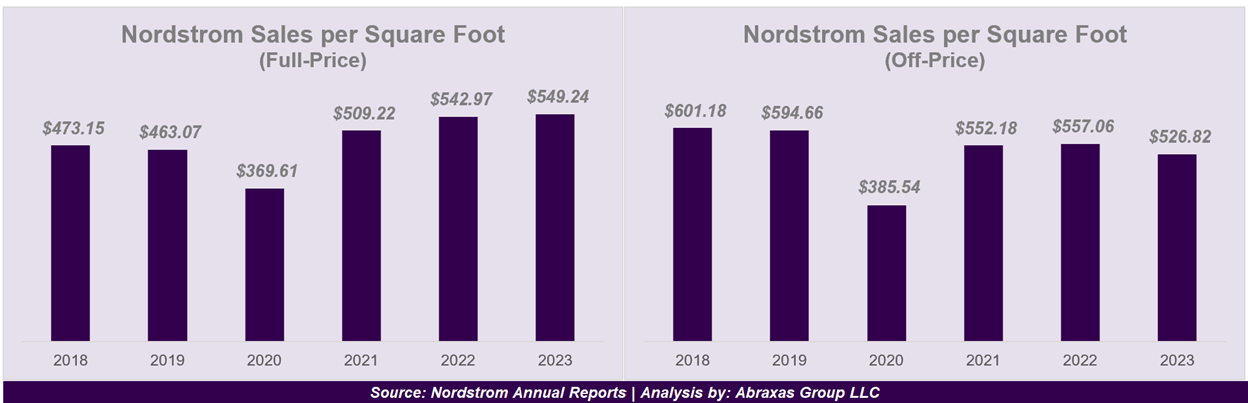
Footprint. The company’s off-price imprint (Nordstrom Rack) has experienced steady growth in store count, while the count of full-price Nordstrom locations has declined (see Exhibit B). It is noteworthy that sales per square foot are up 16.1% at full-price locations (FY23 v FY18), but down 12.4% for off-price locations (see Exhibit C). This may be indicative of a suboptimal store mix. Additionally, with approximately 1/3 of net sales coming from off-price sales, Nordstrom leadership must think carefully about how they are training consumers to think of them, whether or not their current store footprint is in line with how they hope to shape consumer views of the brand, and what store footprint would maximize value creation.
Exhibit B: Footprint
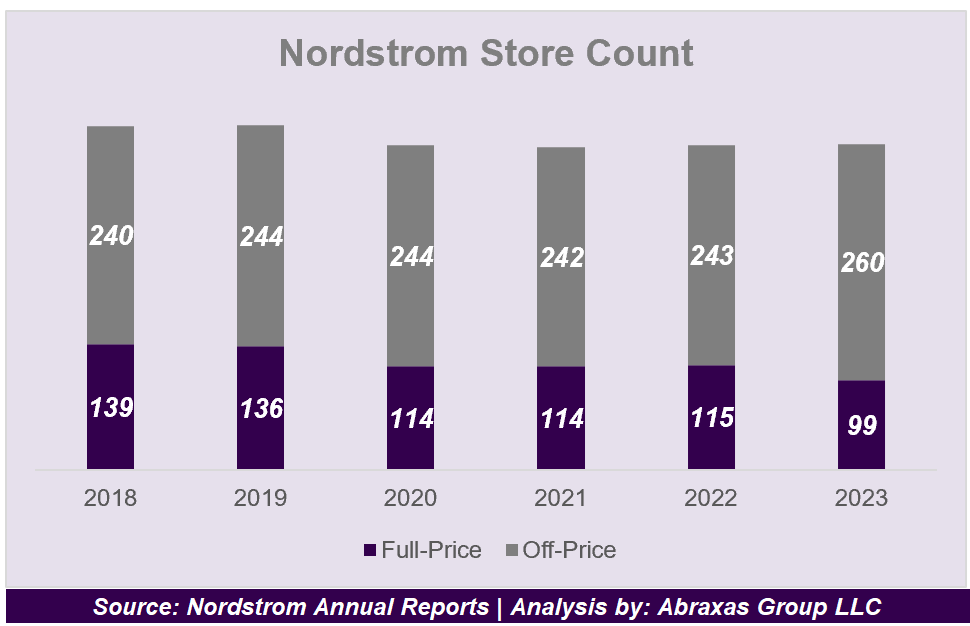
Exhibit C: Sales per Square Foot
Technology. The level of spending on technology has been robust, highlighting a recognition by leadership of the need to enhance their digital capabilities. Between FY20 and FY23, 63% of capital expenditure dollars, or $1.1B, was devoted to technology. This level of investment is not entirely a matter of offense: Nordstrom must boost its technological capabilities to compete in a retail landscape that demands a continual raising of the bar on consumer experiences.
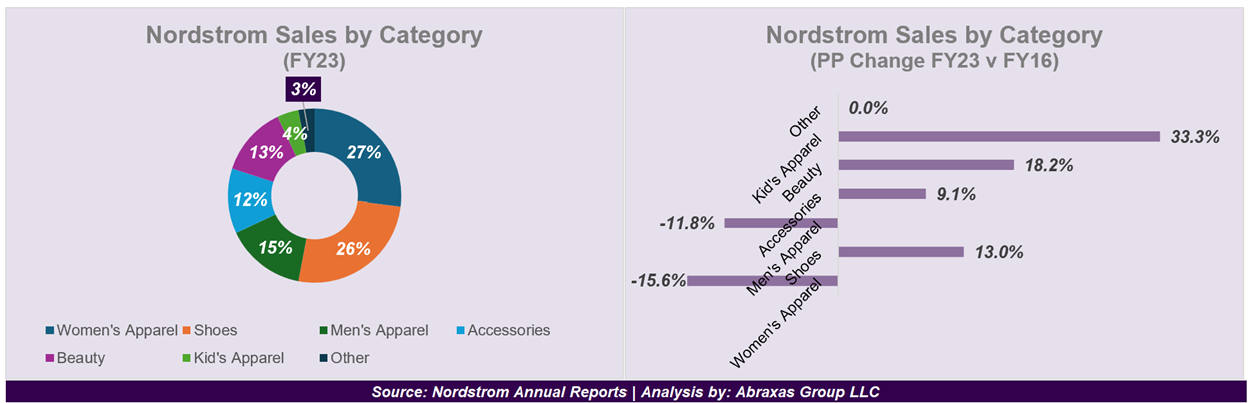
Category Management. In FY16, Women’s Apparel and Shoes represented the top two categories at Nordstrom, accounting for 55% of net sales. Fast-forward to FY23, and those two categories remained at the top, accounting for 53% of net sales. However, there have been considerable shifts in the category weights, suggesting that Nordstrom may have opportunities to drive profit improvement by revisiting how each category is supported (see Exhibit D).
Exhibit D: Category Spend
Digital Sales. Growth in digital sales has been persistent, and at 36% as of FY23, digital sales as a percentage of net sales have increased 20% since FY18 (see Exhibit E). This growth presents operational challenges as legacy retailers such as Nordstrom struggle to offer consumers a seamless omnichannel experience. Supply chain investment has accounted for 15% of capital expenditures between FY20 and FY23, or $274M, and while as a percentage of total capex supply chain investment has declined over that period (from 23% in FY20 to 10% in FY23), the need for continued investment to ensure that Nordstrom delivers on consumer expectations of a seamless omnichannel experience is likely to persist.
Exhibit E: Digital Sales

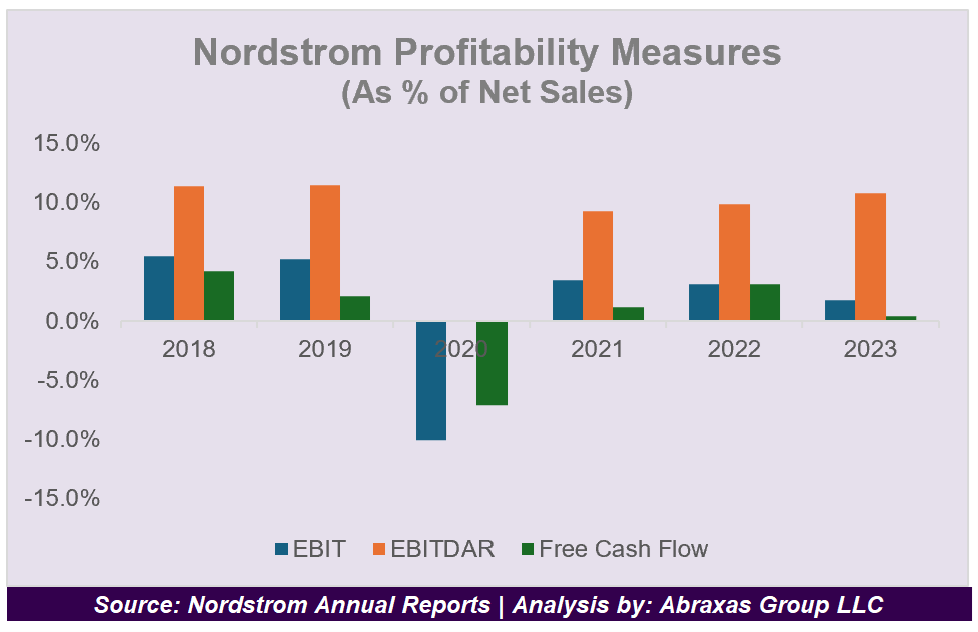
Margins. Nordstrom does not look particularly robust when viewed through the lens of financial performance. EBIT margin has declined by 67.4% from FY18 to FY23. EBITDAR margin looks healthier, having declined by only 4.8%. However, Free Cash Flow margin is down 90.8% over this period. In the face of this performance there is little that leadership can say other than to explain their plan for future improvement. Nordstrom is a smaller business than it was in FY18, and the challenge of pruning revenue while maintaining and preferably growing profitability margins is not an easy one, but these trends are worrisome, and leadership must have an answer (see Exhibit F).
Exhibit F: Margins
Valuation. On the day Nordstrom last announced that the Nordstrom family was exploring a take private initiative (June 8, 2017), the share price closed at $44.63. On September 3, 2024, the day prior to the announcement that the Nordstrom family is again seeking to take the company private, the share price closed at $22.82, or a nearly 50% decrease from the earlier level. Since FY18, Nordstrom stock has severely underperformed vs. the following benchmarks: S&P Retail, S&P 500, and the company’s peer group. With a market capitalization of approximately $3.7B, Nordstrom can be taken private at an attractive valuation, providing downside protection for existing shareholders and allowing the Nordstrom family, owners of approximately 30% of the company (brothers Erik and Peter Nordstrom serve as CEO and President, respectively, of the company) and their partner El Puerto de Liverpool, owner of approximately 10% of the company, to finance a transaction that will add little incremental debt (see Exhibit G) and potentially set the stage for considerable value creation in the years to come.
Exhibit G: Prospective Sources & Uses
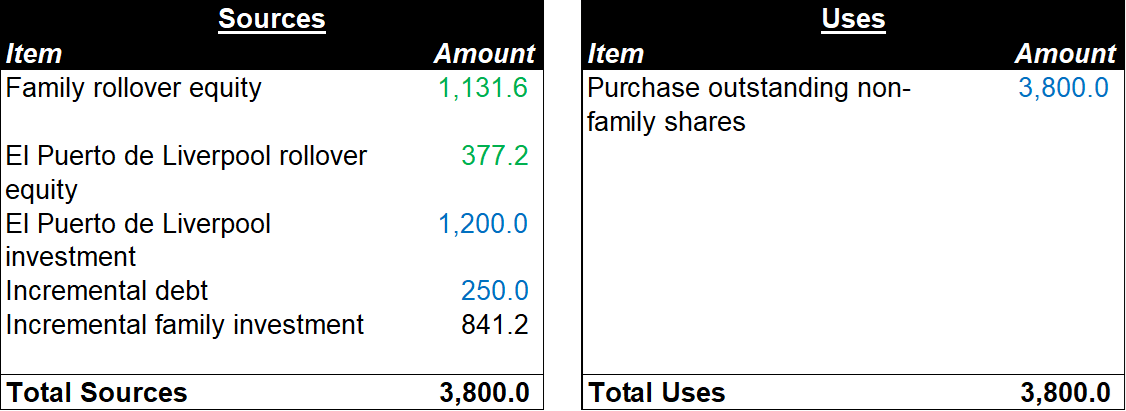
Amounts in $M
Note: Amounts based on reported share holdings of Nordstrom family (30%) and El Puerto de Liverpool (10%)
Lessons for the Rest of Us
The goal of a business transformation is to reset the strategic and operational playing field of an organization. This goal is simple in concept but tremendously difficult in execution. A successful business transformation calls for a rigorous and objective reassessment of an organization’s strengths, weaknesses, opportunities, and threats. The components of each of those elements must be examined in detail. Generally, at the end of this process of reassessment, leadership teams will find themselves faced with the task of fundamentally reimagining substantial aspects of a business, then retooling the business for the current competitive landscape.
A business transformation is an extremely challenging undertaking, and that is partially due to the fact that many decision makers have a tendency to recognize the need for a step change in outcomes while simultaneously denying or downplaying the need for the fundamental organizational change that will support such leaps in performance. Business transformations create the conditions necessary for their own success. When business transformation is viewed as solely the outcome of a change effort, rather than an iterative process the gains momentum over time, something fundamental has been missed.
Kudos to the Nordstrom family for recognizing that the changes to the company necessitated by the wrenching shifts in the retail landscape demand a new set of conditions.
Key takeaways from this example for those of us laboring in the shadows:
Meet external change with internal change. The department store segment is not what it once was, and it is no longer a reasonable thesis to claim that simply surviving the shakeout is enough to drive compelling (or any) value for investors. Leaders and key decision makers looking for lessons from this situation should keep in mind that the level and extent of external change that an organization is grappling with is often a useful guide for the level and extent of internal change that will be necessary for that organization to retool and thrive in a changed landscape.
Align risk tolerances with your capital providers. Too often, companies in need of transformational change assume that their capital providers, both equity and debt, will be along for the ride. This is a dangerous assumption and should be rigorously tested. Investors come in all shapes, sizes, and levels of risk tolerance, and it can be a very painful mistake to embark on a program of transformative change only to find that your partners would prefer to part ways, rather than accompany you on the journey. Often, a change in ownership sets can set the stage for a successful business transformation and radical value creation (as in the case of Dell).
Think big. Change is hard, and transformative change is much, much harder. But the upside is worth it. Perhaps the second greatest danger during a business transformation effort is that key decision makers will declare victory too soon, and put a halt to change efforts after performance has reached a level they deem to be acceptable. The problem is that not every point on the path of business transformation is a point of equilibrium for an organization. In fact, many points are decidedly not points of equilibrium. You can move forward, or you can fall back, but you cannot maintain your place. Countless organizations have suffered this fate. Embrace big goals, and do not stop until you have achieved them. As a simple rule of thumb: ensure that you are not done with your transformation initiative until you have achieved transformative (not merely comfortable) results.
Past success will not save you. We are all subject to countless cognitive biases, but our susceptibility to motivated reasoning is particularly apt for this example. Simply put, business leaders and key decision makers, when faced with the prospect of a need for transformative organizational change, may fail to assess the situation objectively but instead fall back on prior successful performance and fall into a trap of thinking “it is not that bad, we have faced worse and succeeded”. In many ways, this tendency is exactly why I have chosen to highlight the Nordstrom example. Erik and Peter Nordstrom, not only by virtue of their positions at the company but also due to their family history, would seem to have been prime candidates to fall victim to motivated reasoning and an unjustifiably confident mindset of “look at all that we and our family have done, we will overcome this challenge too”. That they did not fall into that trap, but are instead leading, for the second time, an effort to take the company private, increasing their financial exposure in order to drive the change their company needs in order to succeed in a changing landscape, is admirable, and an example to us all.
Conclusion
The case for transformative change at Nordstrom is compelling. At a macro level, department stores have been hard hit by shifts in consumer preferences and the challenges of determining the optimal mix of brick-and-mortar locations in support of a growing digital sales channel. At the micro level, Nordstrom is facing several thorny strategic questions whose resolution are likely to involve gyrations beyond the comfort level of institutional public markets investors in the near and mid-term.
While business transformation has become an increasingly salient option for businesses, it remains exceedingly challenging to execute a successful one. Many organizations struggle to create the conditions for a successful business transformation, preferring to announce aggressive goals absent the hard work of establishing the conditions necessary for the achievement of those goals. For these reasons, any time that the leadership of a company not only recognizes the need for a business transformation but goes on to place their credibility and capital on the line to enhance their likelihood of success, there should be recognition that, at a minimum, things are being put in their proper order, and the conditions for ultimate success are being carefully tended.
About the Author
David Johnson is the founder and managing partner of Abraxas Group, a boutique advisory firm focused on providing leadership and support services to companies in need of transformational change. He is an accomplished thought leader with multiple articles and speaking engagements on the topics of business transformation, change management, performance improvement, restructuring, turnaround, and value creation to his credit. David can be reached at: david@abraxasgp.com.